Late Antique Milan: An Under Considered Period
Before Leonardo there was Ambrose in Milan
Ask someone why they want to visit Milan and you'll probably hear one of three answers: fashion, football (soccer), or Leonardo da Vinci's Last Supper. All perfectly reasonable. But if you're willing to look about a thousand years earlier, and occasionally a few feet below street level (often below a basilica) you'll discover a city that was arguably even more important.
Before Milan became synonymous with luxury shopping and Renaissance masterpieces, it was one of the beating hearts of the late Roman Empire. Emperors ruled from here. Bishops shaped the future of Christianity. Architects experimented with ambitious new church designs while much of Europe was still figuring out what came after Rome. The Renaissance may have given Milan its greatest celebrity, but Late Antiquity gave it its personality.
One of the city's greatest tricks is that it rarely advertises this history. Medieval columns sit quietly beside tram tracks. Ancient walls are incorporated into modern buildings. Entire fourth-century churches survive in neighborhoods where tourists hurry past in search of the Duomo and locals carry about their day. Milan doesn’t directly ask visitors to slow down, but if you do, you will be amazed at what lies below this modern metropolis.
The story begins in the fourth century, when Milan was far more than a prosperous northern Italian city. It served as an imperial capital of the western Roman Empire, placing it at the center of politics just as Christianity was transforming from a persecuted religion into an imperial institution. This was the city where emperors made decisions that reshaped the Roman Empire, and where bishops increasingly became as powerful as politicians.
No figure embodies that better than Ambrose.
Ambrose: The Man, the Myth, the Saint
If you've ever wondered why one bishop has an entire neighborhood and one of Italy's greatest churches named after him, it's because Ambrose wasn't simply a religious leader. He challenged emperors, wrote influential theology, helped define Christian liturgy, and generally behaved like someone who knew exactly how much influence he wielded. In many ways, he helped establish the later medieval model of the powerful bishop who could stand toe-to-toe with kings.
One of the things I love about Ambrose is that he wasn't even a career churchman. He began as the Roman governor of Milan and was unexpectedly chosen as bishop before he'd even been baptized. Within a week, he had raced through the clerical ranks. Years later, he would famously force an emperor to do public penance—a remarkable reminder that, in Milan, bishops could wield as much authority as emperors.
Basilica of Sant'Ambrogio
His legacy lives on in the Basilica of Sant'Ambrogio, one of the finest surviving late antique churches. Unlike many churches that have been endlessly remodeled, Sant'Ambrogio still preserves much of its distinctly medieval character. Walking into its brick courtyard feels surprisingly intimate, almost understated, before the church unfolds into broad arcades and soaring vaults. The Romanesque architecture surrounding it reflects centuries of continuous devotion layered atop Ambrose's original fourth-century foundation.
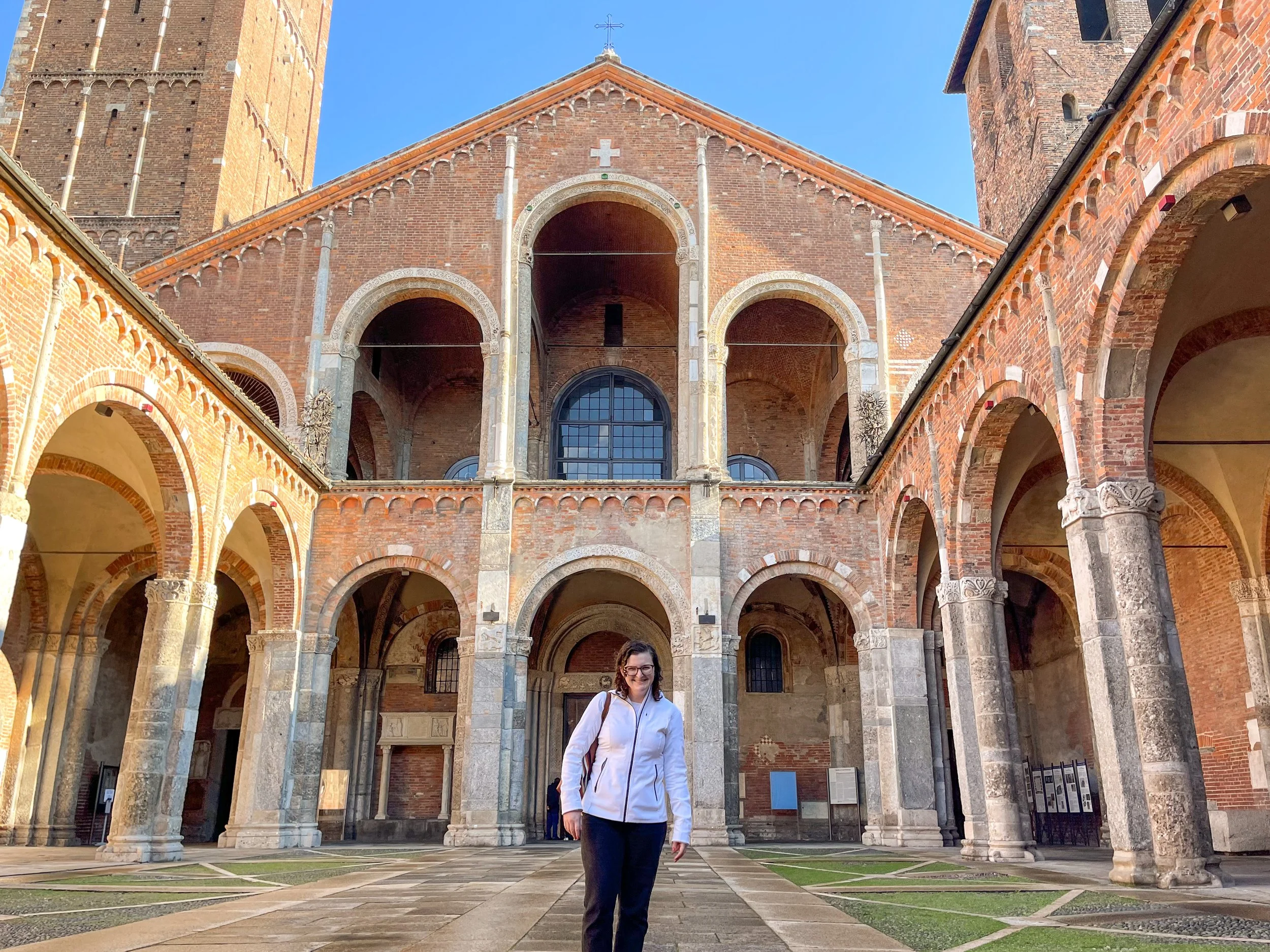
For me, Sant'Ambrogio carries an unexpected sense of familiarity. I spent years at UCLA completing my undergrad and PhD in Byzantine art history, and every time I visit the basilica, I can't help thinking about Royce Hall. UCLA's iconic Romanesque landmark—with its brick towers, rounded arches, and Lombard inspiration—owes much of its aesthetic vocabulary to the church of Sant'Ambrogio. It's a reminder that medieval architecture never really disappeared; it simply found new audiences in unexpected places. Standing in ninth-century Milan while mentally connecting the dots to a university campus in Los Angeles is exactly the sort of delightful historical whiplash that art historians secretly live for.
Basilica of San Lorenzo
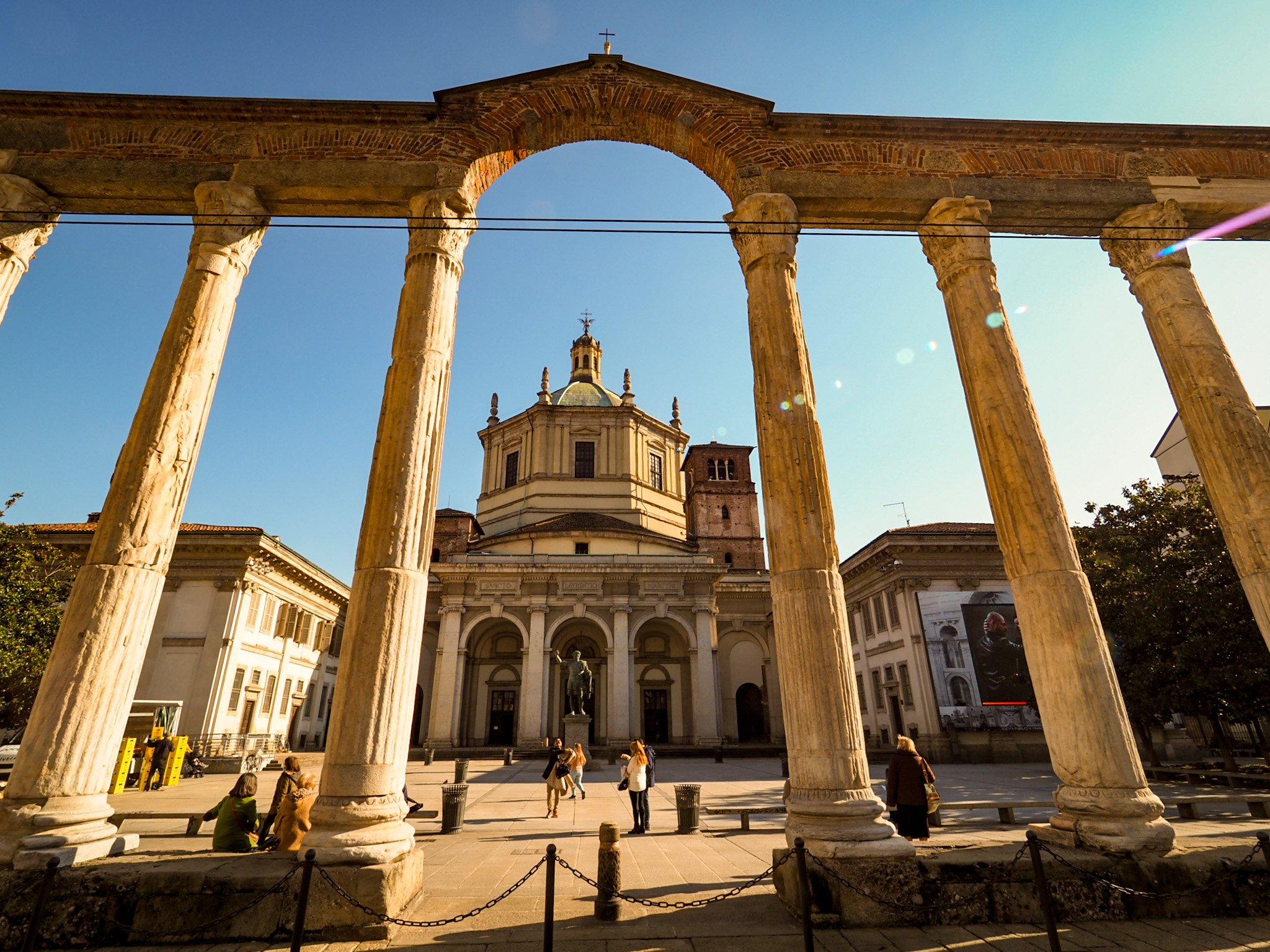
A short walk away stands another architectural surprise: the Basilica of San Lorenzo. If Sant'Ambrogio represents the medieval soul of Milan, San Lorenzo showcases the city's late Roman ambition. The church's central plan immediately feels different from the long basilican layouts familiar from many early Christian churches. Massive spaces unfold beneath a soaring dome, while giant reused Roman columns outside hint at the church’s position along what was once the city's imperial processional route. The building has endured fires, collapses, and centuries of restoration (including one during the first time I tried to visit on a special stopover between Rome and Venice), but its underlying fourth-century conception still feels remarkably bold and innovative.
Centralized churches like San Lorenzo were relatively unusual in the West but found greater popularity in the eastern Mediterranean, particularly in the seventh century and onwards. Cities such as Constantinople embraced domed architecture with particular enthusiasm. Looking at San Lorenzo, it's easy to see Milan provoking artistic conversations that stretched across the Roman Empire rather than existing on its distant edge.
Hidden almost inconspicuously within San Lorenzo is one of Milan's greatest artistic treasures: the Cappella di Sant’Aquilino. If you enjoy those magical moments where modern traffic disappears and sixteen hundred years suddenly feel very recent, this is your place.
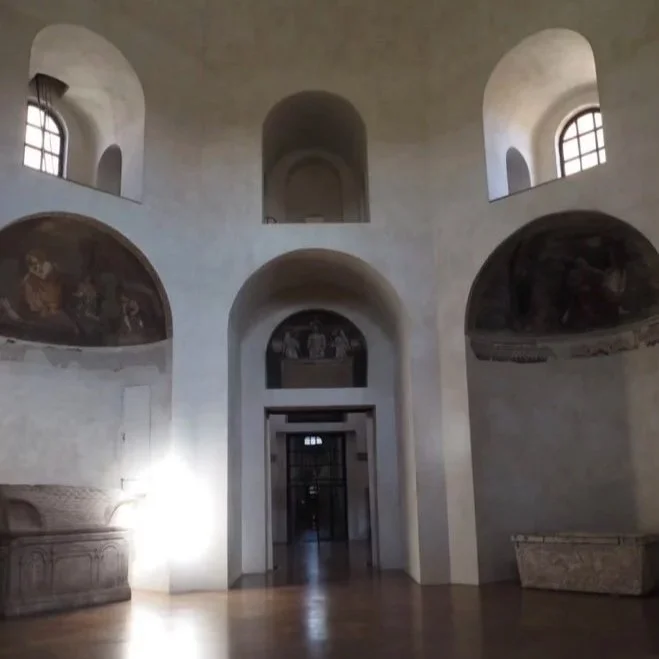
Originally built as an imperial mausoleum or chapel in the late fourth century, Sant'Aquilino preserves extraordinary early Christian mosaics that rank among the oldest surviving examples. Christ appears not only as the familiar bearded teacher but also in youthful classical forms that remind us just how closely early Christian artists borrowed from Roman visual tradition.
To summarize…
This is one of the reasons I initially fell in love with Late Antiquity. The period constantly refuses neat categories and demands nuance. Pagan imagery did not simply disappear overnight; it evolved and was repurposed. Roman architectural traditions became Christian spaces. Classical artistic language develops new theological meanings. The result isn't decline, despite what older history books liked to suggest. It's creative adaptation. And Milan excelled at that adaptation.
The city's position at the crossroads of northern Europe and the Mediterranean made it a cultural meeting place. Roman engineering, Christian theology, and artistic influences flowing from both East and West all converged here. Even after the political center of gravity shifted elsewhere, Milan remained an important ecclesiastical city whose bishops, churches, and artistic traditions continued shaping medieval Italy.
Perhaps that's why Milan's earlier history feels so rewarding to explore today. Unlike Florence, whose Renaissance identity is impossible to ignore, Milan's ancient past remains something of an open secret. You won't find shoulder-to-shoulder crowds photographing every fourth-century mosaic. Instead, you'll wander into churches where history quietly accumulates in layers: Roman foundations beneath medieval brickwork beneath modern city life.
The Last Supper remains one of the defining achievements of Western art and should be visited at least once. But the visit at times feels restrictive and rushed, with long lines, exacting time slots and a guide there to keep in line at all times. Reducing Milan to Leonardo is a little like visiting Rome only for the Colosseum. You're seeing an extraordinary chapter while skipping the first half of the story. So by all means, reserve your ticket for The Last Supper. Browse the boutiques. Enjoy the aperitivo. Then spend an afternoon with Ambrose instead.