The Emperor Who Never Visited His Own Portrait
Justinian in Ravenna
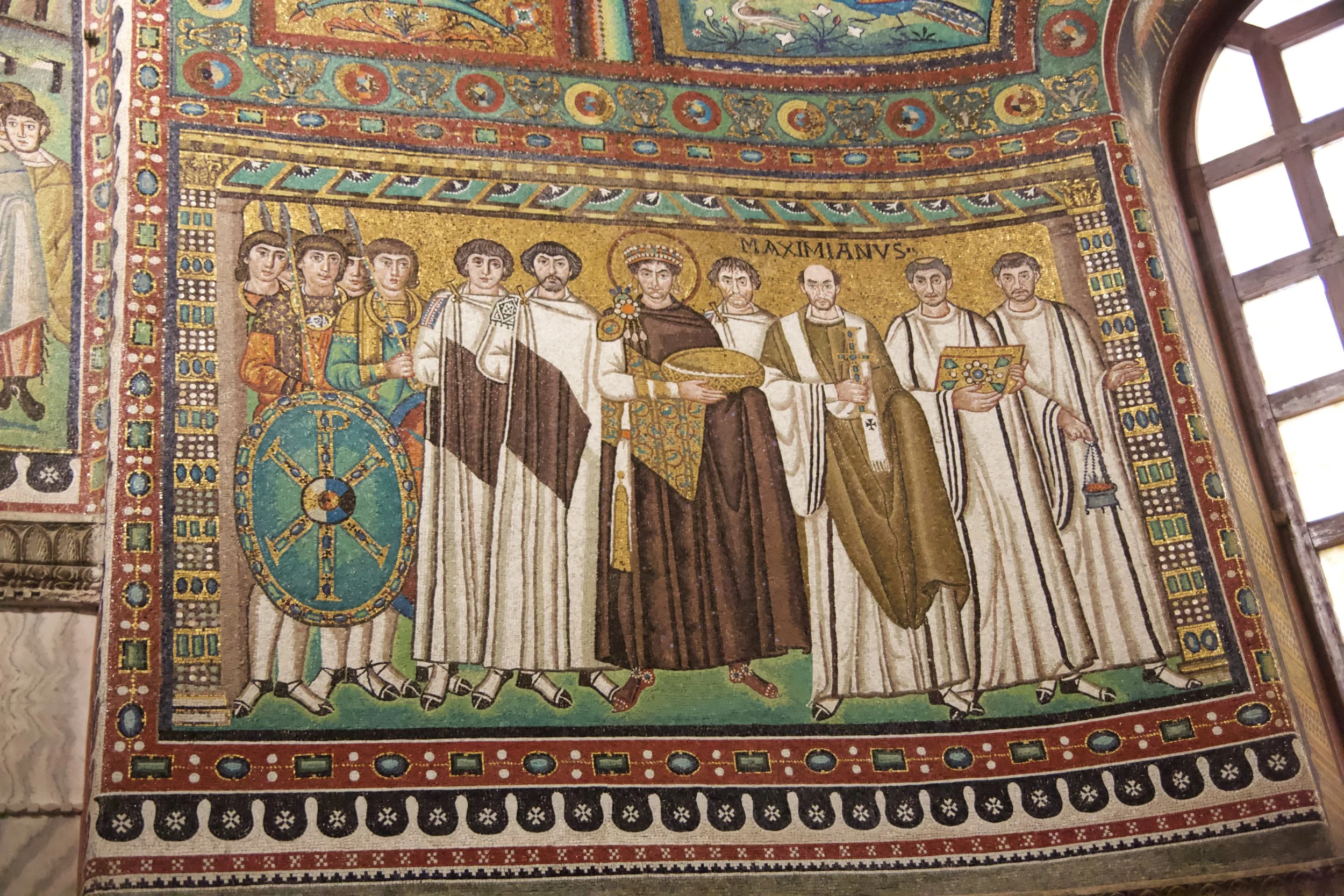
Most famous portraits of history tend to have one thing in common: at some point, the sitter probably saw them. Not so for Emperor Justinian and his stunning mosaic portrait in the Basilica of San Vitale in Ravenna. The remarkable sixth-century mosaic of Justinian depicts him crowned with a golden halo, dressed in imperial purple, and flanked by soldiers, clergy, and court officials. Opposite his depiction in the apse, his wife Theodora processes with similar pomp. Both appear to stride toward the altar with palpable majesty. It's one of the most recognizable images of Byzantine art, appearing in nearly every art history textbook ever assigned to unsuspecting undergraduates.
There's just one thing: Justinian almost certainly never visited Ravenna to see it. In fact, the face staring back at millions of visitors, both in person and via books and websites, was probably created by artists who had never seen the emperor in person. That raises an interesting question: if the emperor isn't actually there, what exactly are we looking at? The answer tells us quite a bit about how the Byzantine Empire understood power.
Ravenna: The Western Capital That Refused to Go Quietly
To understand why Justinian appears in a church nearly 1,300 miles from Constantinople, we first have to understand Ravenna. Today it feels almost sleepy, famous primarily for mosaics and a delectable local sandwich known as the paidina. In Late Antiquity, however, Ravenna was one of the most politically important cities in Europe. It served as the capital of the Western Roman Empire beginning in the early fifth century before becoming the capital of the Ostrogothic Kingdom under Theodoric the Great. Although the Goths admired Roman administration and culture, they were Christians who followed Arian Christianity rather than the Nicene Christianity supported by the imperial court in Constantinople. Religion and politics were hopelessly intertwined, so theological disagreement also represented competing claims to authority.
When Justinian launched his campaigns to reconquer Italy in the sixth century, Ravenna became far more than another military objective. Taking the city meant reclaiming an imperial capital, reasserting Orthodox Christianity, and demonstrating that the Roman Empire had never truly disappeared in the intervening period after the Theodosian Dynasty.
An Emperor by Long Distance
Here's the curious part…
Construction on San Vitale began while Ravenna was still under Ostrogothic rule. By the time the church was consecrated in 547, Justinian's armies had recaptured the city. Yet there is no convincing evidence that Justinian ever made the journey from Constantinople to Ravenna. He didn't need to. Instead, his triumphal arrival to the conquered city arrived in mosaic.
Scholars generally believe the portrait was probably based on official imperial imagery rather than a life sitting. Coins are the leading candidate. Throughout the Byzantine Empire, imperial mints produced thousands upon thousands of coins carrying standardized portraits of the emperor. They functioned like an official logo: consistent, recognizable, and politically useful. The mosaic artists translated that familiar imperial image into shimmering glass tesserae. This explains why Justinian's face feels strangely timeless. He isn't individualized. There are no wrinkles, no signs of age, no quirks that suggest a living person. Instead, we encounter the office of emperor embodied in human form. He's less a portrait than an institution.
Standing at the Center of the Universe
Justinian occupies the exact center of the composition. Everyone else's gaze, movement, and position reinforces his importance. To one side stand soldiers carrying shields emblazoned with the Chi-Rho, the symbol of Christ. On the other side stand clergy, including Bishop Maximian, whose name was inserted directly into the mosaic. The emperor bridges both worlds. He isn't shown merely a military commander or a political ruler. Nor is a priest. Instead, he occupies the space between church and state, suggesting that imperial authority holds all roles together in his position of divine rule. The mosaic presents the emperor as an active participant in every liturgy celebrated beneath it.
The Emperor Who Is Everywhere
So what does it mean when the emperor is everywhere except physically present? For modern audiences, leadership is often tied to visibility. Politicians campaign in person, kissing babies and speaking to the “common” man. CEOs tour factories and show off their fast food chain’s latest burger. We value authenticity and physical presence, even when ultimately manufactured.
The Byzantine Empire worked differently. Power spread through images. An official portrait wasn't merely decorative; it made imperial authority tangible. Whether carved into ivory, stamped onto a coin, or assembled from thousands of glittering tesserae, the emperor's likeness carried political weight. Seeing Justinian meant encountering imperial order itself.
The image did not simply remind viewers of the emperor. In a meaningful sense, it stood in for him. That's why the mosaic feels so commanding even today. Justinian looks directly outward, detached from any fleeting moment. He doesn't appear to be entering the church as much as existing perpetually within it. His body may have remained in Constantinople, but his authority extended wherever his image appeared.
Fifteen Hundred Years Later
The artists assumed that a man could govern lands he would never visit, influence people he would never meet, and remain permanently present through carefully constructed images. Oddly enough, that idea doesn't feel entirely foreign anymore. We routinely know public figures through photographs, broadcasts, and carefully managed online personas rather than in-person encounters. Influence has long outgrown physical presence. Justinian simply accomplished it with gold glass instead of pixels. And fifteen centuries later, visitors continue making the pilgrimage to meet an emperor who never came to meet them.