Inside the Vatican Library
No, I Wasn't Hunting for the Holy Grail
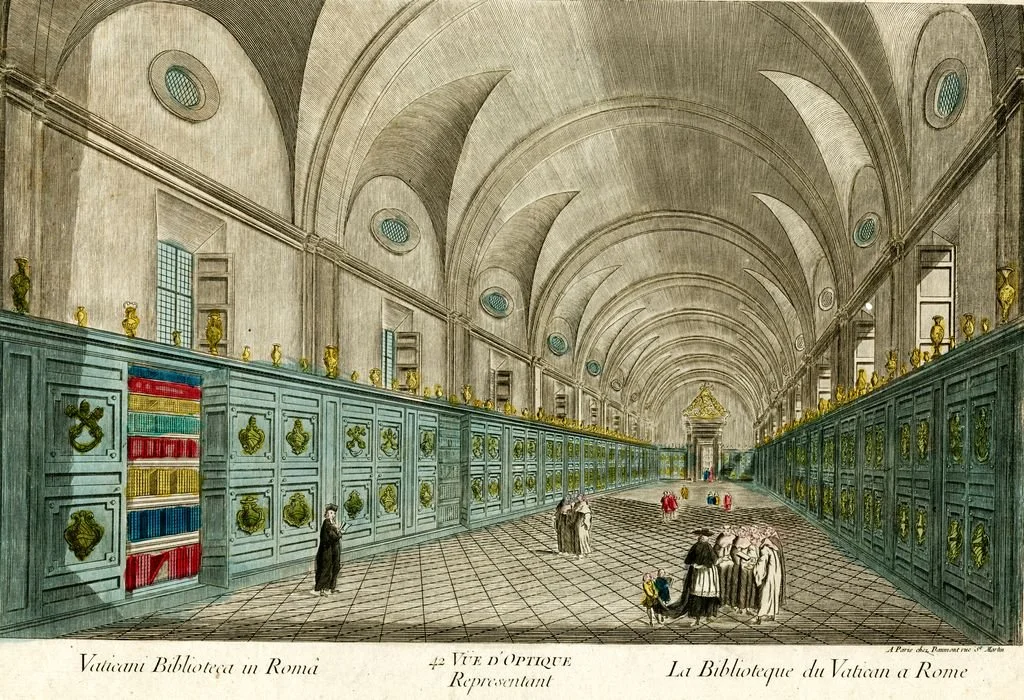
BAV, Stampe III.247, pl. 2, etching, engraving and watercolor, second half of
18th century. View of the Vatican Library.
https://www.vaticanlibrary.va/en/the-library/history-of-BAV.html
There are certain phrases that immediately make people think you have wandered into a Dan Brown novel.
“I spent the day in the Vatican.”
“I was doing research in an undisclosed location.”
“I was working in the Vatican Library.”
The last one is particularly effective.
Mention that you went deeper into the Vatican than the average tourist and people tend to look at you as though you are about to reveal that you found a secret passage, an ancient papal conspiracy, or perhaps a particularly angry Swiss Guard guarding the Holy Grail.
Sadly, my time in the Vatican Library involved considerably less international intrigue and considerably more Latin.
But getting inside is still a rather extraordinary experience.
The Library Is Not the Archives
First, an important distinction: the Vatican Library and the Vatican Apostolic Archives are two different institutions.
The archives are, broadly speaking, where the records of the Holy See are preserved: official documents, correspondence, administrative records, and the accumulated paperwork of centuries of papal government. The library, on the other hand, is a research library containing an extraordinary collection of manuscripts, books, prints, and other materials.
Both are associated with the Vatican and both have cardinals wandering around, which does little to dispel the Dan Brown atmosphere.
For an art historian, however, the library is particularly exciting because it contains the sort of primary sources that can make you forget that you have been staring at the same Latin sentence for forty-five minutes.
Getting access is also somewhat more involved than walking through the front door of your local public library.
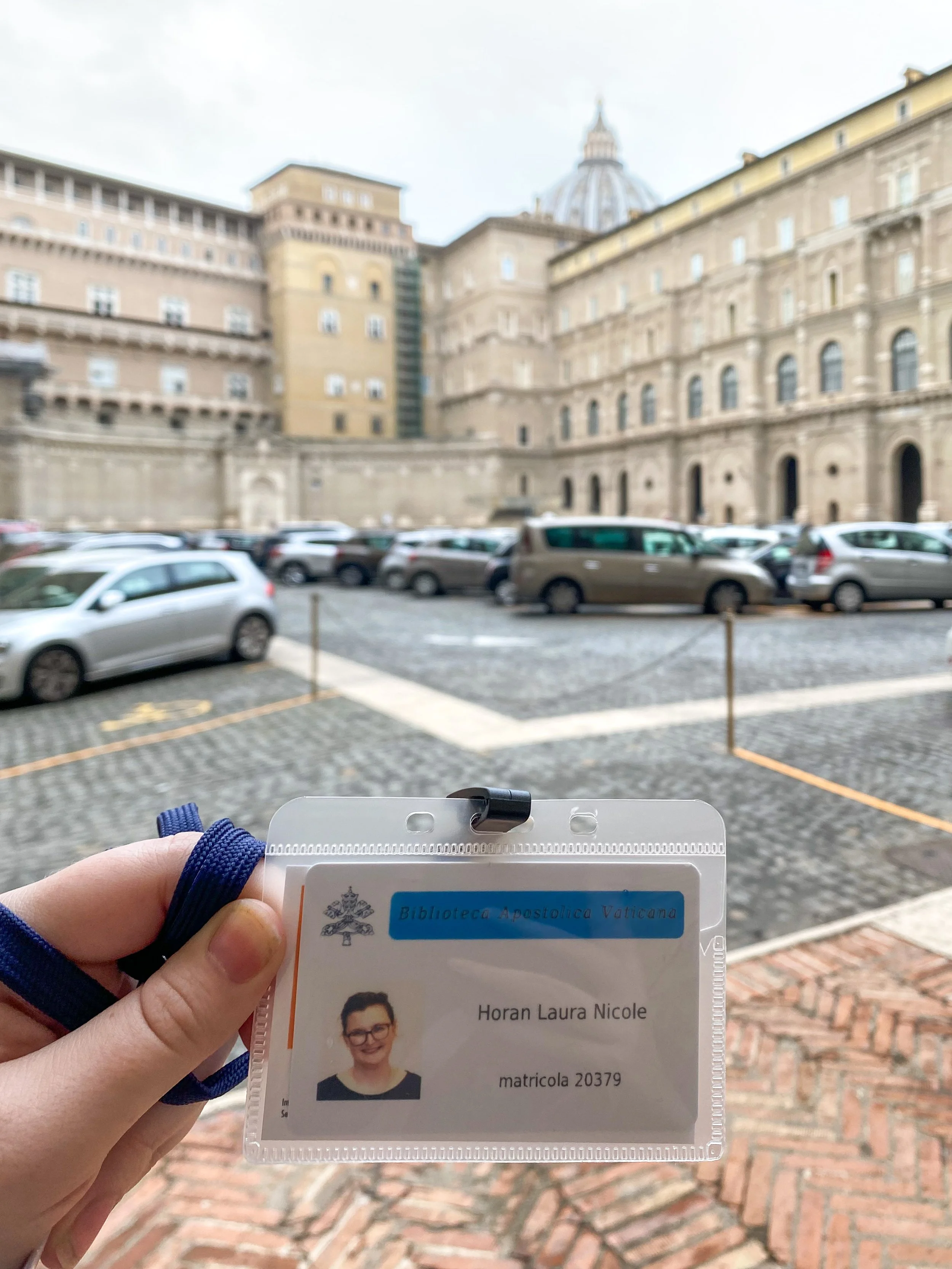
The illustrious entrance to the library…a car park
Getting In
You cannot simply show up at the Vatican Library and announce that you would like to see some medieval manuscripts.
To gain access as a researcher, you need appropriate academic credentials and, among other things, a letter from your supervisor or institution explaining who you are and why you need to be there. There is paperwork. There are rules. There are permissions.
And then there is the small matter of agreeing to be tracked throughout the library.
Which sounds much more sinister than it actually is.
The Vatican Library is a highly controlled research environment, so researchers are monitored as they move through the building and its various areas. You know where you are supposed to be, and the Vatican knows where you are supposed to be. It is less Angels & Demons and more very serious library security.
You also quickly discover that the Vatican has very definite opinions about what you need to bring into a library.
The answer is: almost nothing.
Bags are not allowed in the reading rooms. You bring your computer or notebook and a pencil, and that is about it. The modern researcher, accustomed to arriving at a library carrying enough electronic equipment to establish a small command center, is forced to pare things down considerably.
And then you walk inside.
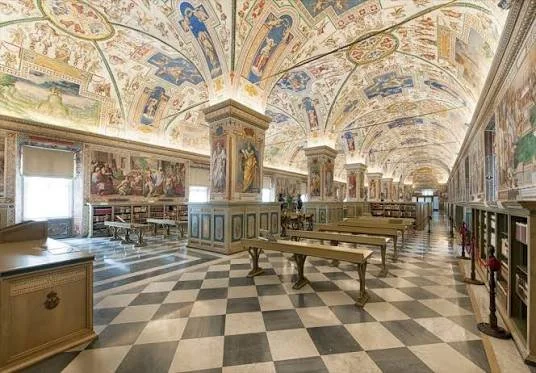
A Library Frozen in Time
The remarkable thing about entering the Vatican Library is that the atmosphere changes almost immediately.
You have left modern Vatican City behind, and suddenly you are sitting in a space that feels deeply connected to the centuries of scholarship that happened there before you.
I primarily worked in the Sistine Hall, one of the most spectacular spaces in the library.
The room is lined with long wooden tables where researchers sit and work. The setting is simultaneously beautiful and slightly intimidating. You are surrounded by the physical remnants of centuries of intellectual history, and you are expected to behave as though this is a completely normal place to spend a Tuesday afternoon.
The ceilings do not exactly help with concentration.
They are covered in incredibly elaborate painted decoration—ornament, architectural illusion, figures, and intricate details stretching overhead. It is the sort of ceiling that makes you feel that perhaps you should be doing something more profound than squinting at your notes.
Fortunately, it also provides an excellent excuse to look up every so often. Especially when you have been transcribing searching ancient inscription records for several hours.
There Is No "Just Make a Copy"
One of the biggest differences between working in the Vatican Library and working in a modern research library is how physical the process of research can feel. Spoiler: there are no photocopiers waiting conveniently around the corner. And taking pictures of the book pages on your phone is not allowed. In fact phones were not permitted at all when I was there.
If you want to consult a particular book or manuscript, you submit a physical requisition form. You write down what you want, hand it over, and then you wait.
And wait.
And eventually, usually somewhere around thirty to sixty minutes later, your requested item appears.
This is not the sort of library where you casually wander through the stacks looking for something interesting.
You request.
You wait.
You receive.
You work.
And if you suddenly realize that the book you actually need is the one sitting three shelves over from the one you requested, congratulations: you get to fill out another form.
It can feel almost comically old-fashioned.
And yet, there is something wonderful about it.
In an age when we have become accustomed to downloading an article in seconds, searching millions of books with a few keystrokes, and photographing anything we might possibly need later, the Vatican Library forces you to slow down.
You have to know what you are looking for.
You have to request it.
You have to wait for it.
And then you have to actually read it.
The Strange Experience of Being There
That may be what I remember most about working in the Vatican Library.
It is not just that the building is beautiful or that the collections are extraordinary. It is the strange sensation of participating, however briefly, in a tradition of scholarship that stretches back centuries.
You sit at a wooden table beneath an elaborately painted ceiling. Somewhere nearby, another researcher is working through a manuscript. You are surrounded by books and documents that have been studied by generations of scholars before you.
And you are doing something remarkably mundane.
You are taking notes.
You are transcribing Latin.
You are waiting for a book.
You are trying to decipher someone's handwriting from several hundred years ago and quietly wondering what, exactly, they were thinking when they decided that those letters should look like that.
It is simultaneously awe-inspiring and deeply ordinary.
And perhaps that is what makes the experience so memorable.
The Vatican Library is not a secret chamber hidden beneath St. Peter's Basilica. There is no ancient brotherhood waiting to reveal the truth about Christianity. I did not discover a shocking document that would have required me to flee Rome.
I just went to the library.
But what a library.
For someone who spends a great deal of time thinking about the people, objects, and ideas of the distant past, there is something uniquely thrilling about sitting in a room where centuries of that past are physically present around you.
So the next time someone tells you they have been “inside the Vatican,” you might ask a follow-up question.
Because there is a very big difference between seeing the Sistine Chapel with thousands of other tourists and sitting beneath the painted ceilings of the Sistine Hall, waiting thirty minutes for a centuries-old book to arrive on a little wooden cart.
And if you happen to mention that you spent the day there researching medieval manuscripts, be prepared for the inevitable question:
“So... did you find anything secret?”
No.
But I did find a lot of Latin.